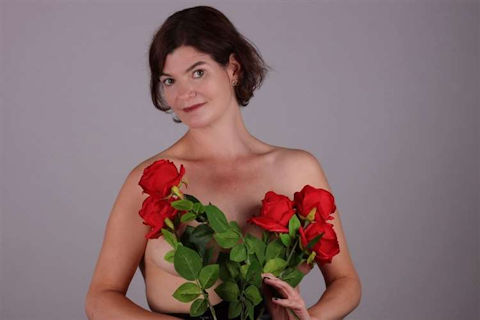
Performers like Marceline V.Q. say they are reclaiming rope bondage for modern times.
Source: Thedailybeast.com
USA – As she skillfully tied her partner onto a steel suspension tripod, Marceline V.Q. let her inspiration lead her. Using natural hemp ropes to recreate a scene from Michelangelo’s well-known fresco painting, The Creation of Adam, Marceline pondered every reaction her partner made, as the woman hung in midair.

Her partner’s arm stretched out to reach something powerful yet invisible. Smiling, with her eyes closed, she looked totally absorbed.
“Something I really adore is just the feeling of rope flowing through my hands,” Marceline said, gesturing to mimic the rope moving. “You get into a flow state.”
By day, Marceline, 26, is an engineering researcher and a physics Ph.D. By night, she is a rope bondage artist and educator. Her pseudonym, “Marceline V.Q.,” is adapted from the character “Marceline the Vampire Queen” in the cartoon series Adventure Time, as she wished to keep her academic life separate from her rope bondage gigs. She tries to constantly challenge the world of BDSM—bondage, domination, submission, and masochism—with aesthetic concepts and complex rope techniques.
“When I was starting out, the struggle for me was trying to show people who weren’t involved in this that rope bondage doesn’t have to always be about sex,” she said. Although for her, it is and it isn’t.
Before the pandemic hit, she was invited to perform and to teach a class called the “physics of ropes” all over the country. Combining her artistic and scientific skills, she uses geometry to inspire most of her rope bondage work.
“When creating rope bondage work, I’ll take the idea of translating a four-dimensional object into three dimensions,” she said. “I’m sort of turning off the analytical side of my brain and feeling more than thinking, in a lot of ways. That’s unusual for people doing very intense mental work.”
However, Marceline’s rope bondage experiences weren’t always artistic. Smiling shyly, she admitted the “epiphany” moment came when she was playing a game of “cops and robbers” with her friend when she was 10 years old. Tying her friend’s hands behind the back with a rope, Marceline had this exhilarating feeling of stepping back to appreciate her “artwork” and thinking she wanted to be part of it.
“I think people understand their sexuality a lot earlier than they realized,” she said.
Marceline began her rope bondage journey in 2014 when she found out about several BDSM subculture groups on FetLife, the social network for the BDSM and kink communities. There she discovered “kinkers,” who go beyond what are considered conventional sexual practices. They don’t “practice” rope bondage. They “play” it.
Rope bondage, or “shibari,” originated from the Japanese martial art of restraining captives and then transformed into erotic bondage in the late 19th century, according to the first English instruction book on Shibari. “Shibari is a Japanese form of sex play using rope restraint methods. It may or may not be sexual, but it is certainly centered around joy and delight and play,” said Midori, the acclaimed sexologist and author of The Seductive Art of Japanese Bondage.“Even though most of the work I produced in rope doesn’t tend to be very sexual, I don’t want to completely separate myself from those origins, because that’s why we’re here today.”
The view of rope bondage has not been consistent over time. After studying in Japan for several months in 2017, Marceline says she noticed a slight shift in shibari communities. Some members started to consider rope bondage as art, which completely erased its “messy, dirty” history.
“Even though most of the work I produced in rope doesn’t tend to be very sexual, I don’t want to completely separate myself from those origins, because that’s why we’re here today,” Marceline said.
Midori also believes that learning rope bondage’s origin is essential. “Saying, ‘I am practicing this as art’ is pretentious,” said the sexologist, furiously. “It’s about elevating one’s own social prestige.”
Following the release of the erotic book Fifty Shades of Grey, kink subcultures gained mainstream momentum in 2011. Kink behaviors are common among adults in America, according to a 2017 study from Indiana University’s Center for Sexual Health Promotion. More than 30 percent of those surveyed acknowledged they had engaged in spanking, more than 22 percent engaged in role-playing, and more than 20 percent engaged in rope bondage.
“Fifty Shades of Grey changed the way people view kink and opened up the conversation about consent,” said Susan Wright, the spokesperson of the National Coalition of Sexual Freedom (NCSF), a nonprofit organization that advocates for the sexual freedom of all adults.
Although a number of films and books have thrust BDSM into the realm of popular culture, rope bondage is still taboo for a lot of people. Some feminist activists expressed strong opposition. “I do not believe meaningful sexual liberation is achieved through replicating the same dominance-subordination dynamics of institutionalized male dominance,” said Caitlin Roper, a feminist activist and a Ph.D. candidate researching female-shaped sex dolls. “With an understanding of feminism as a collective movement to liberate women as a whole from patriarchal oppression, I do not believe there is a feminist case for male violence and degradation of women, even if some women consent to it or say they like it.”
In the past few years, the National Coalition of Sexual Freedom saw a rising number of female dominant and queer people in kink subcultures. Marceline has mixed views toward the use of gender in the interpretation of BDSM. “Feminism is about giving women the agency to decide what’s best for themselves. I am one of those women who finds sexual liberation in kink subcultures, but there’s certainly an opportunity for really shitty people to get involved in the scene and use that for their own purposes,” she explained.
Reclaiming rope bondage’s versatility in the modern context, Marceline now believes that kink subcultures can be both sexual and visceral. She enjoys the interplay between the physical posing and the emotional components of it.
“You can think of rope like an intimate massage, or you can think of rope like a workout or therapy,” she said. “It’s like dancing.”