
Source: SMH.com.au.
AUSTRALIA – SIDNEY – As Sydney springs back to life, we reveal its untold stories. In the first of our series about the things we don’t speak about, we look at the challenges in the sex industry.
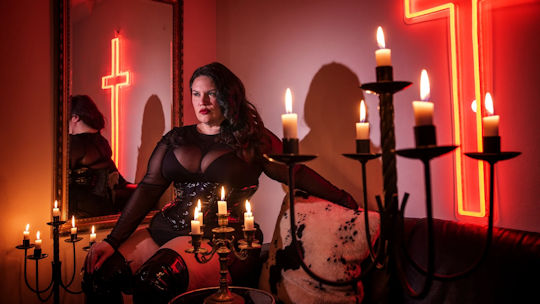
There’s more to Mistress Lucilla than her tight corset, high-heeled boots and riding crop. There’s also her master’s degree in psychology, the book she’s writing and her intricate understanding of society.
When I ask her about the large neon crucifix on her wall, she responds, “it’s a place of worship isn’t it?” And, she’s right. Some people worship her for the things she can do.
Even though sex work has been decriminalised since 1995 in NSW, the sex industry still operates largely behind closed doors, and is spoken about in whispers. That is, of course, unless you speak to the people who work in it.
“You often get the question of ‘Why do you do this? Are you being coerced into it?’ Or ‘How can I save you?’ ” Mistress Lucilla said.
“I don’t need saving. I am here to save you, really. I don’t do this for the money. It’s about how many positive life experiences can I offer somebody.”
More people have started to dip their toes in the bondage waters, says Mistress Lucilla, taking the opportunity post-lockdowns to try something new or explore sexual fantasies.
“I’m seeing a wave of what I am calling ‘the bucket listers’. People wanting to try it once, see what it’s like and most likely never do it again.”
The pandemic has had a diverse effect on how the sex industry operates, and with inflation and interest rates on the rise, Mistress Lucilla said that sex is one of the first industries to feel the pinch.
“People get nervous about where they’re spending their money, how they’re spending their money, and pulling inward in the hope to survive.”
Just like any other business, there are peaks and troughs when it comes to demand.
Despite the popularity of her bridles and gags around Melbourne Cup time, Mistress Lucilla said that the racing carnival marks the start of people taking their money elsewhere.
“From Melbourne Cup Day, it starts to get really quiet because everyone’s transitioning to party season.
“And then Christmas parties start, and everyone starts preparing for holidays … so client money will be going to Christmas presents, holidays, and then kids go back to school and people have to pay their credit card bills. So normally, about November through to about the end of February it gets very patchy.”
Jess and Lawrence, owners of swingers club Our Secret Spot in Annandale, had a similar experience to Mistress Lucilla, in that the pandemic sparked a stampede of people who wanted to spice up their sex lives.
“It’s de facto prohibition,” Bates said.
She says that brothels don’t belong “out in the boondocks around smash repair yards” because it “is a most unsuitable and dangerous place for a mostly female workforce to be. Once the sun sets, everybody goes home … There are no trains, no transport, and the clients are scared too.”
As the industry continues to shed stigmas around sex work and workers, it allows services to become more accessible to people who have previously had difficulty accessing premises and finding sex workers.
Rachel Wotton, an academic, sex worker and activist, has been working for more than 20 years to increase the rights of sex workers, as well as the sexual rights for people with disability to access sex worker services if they choose.
Her PhD research is on exploring the experiences of people with disability who access sex work services in Australia.
She says that “the sexual rights of people with disability is still an incredibly contentious issue”, and that these issues are often coupled with poor accessibility of venues, society still not viewing people with disability as sexual human beings and unclear policies in disability organisations around supporting peoples’ sexual and relationship needs.
“Third-party support and support workers can either be the best advocates or the worst gatekeepers,” said Wotton.
Although a lot of progress has been made in dismantling stigmas around sex work and those who access it, Wotton said that there is still a long way to go.
“Things that need to change include … More positive media outlining sex work as real work and for people to stop demonising clients.”
And also, “allow sex workers from other countries to get work visas equal to other occupations and industries”.
Put simply, allow them to work, pay their bills and provide for their families equal to any other occupation. Because, at the end of the day, they’re just doing their job.
